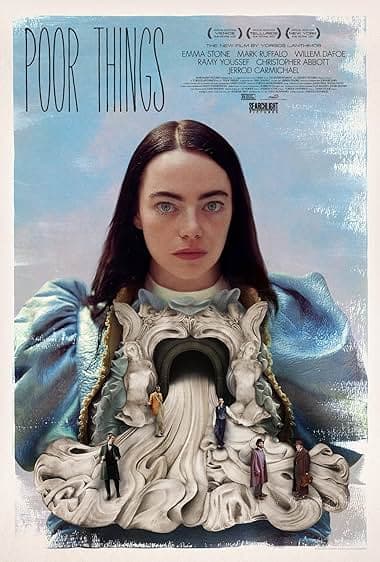
⚠️ Contains spoilers.
🧂 Poor Things (2023)
A grown woman reinvents herself from scratch, and somehow the fish-eye lens is the least surreal thing about it.
Directed by Yorgos Lanthimos. Distributed by Searchlight Pictures. 2023.
🧂 Salt: 5 / 10. A back half that runs out of new places to go, and a hero whose growth gets told more than shown by the end. and ⭐ Stars: 8 / 10. One of the best films of its year, full stop.
She was born a grown woman and immediately started outgrowing everyone in the room.
Yorgos Lanthimos has spent a career finding the cruelty hiding inside politeness, and Poor Things is the film where he finally lets a character claw her way out of it. Bella Baxter (Emma Stone) is a pregnant woman who drowned herself and got resurrected by the scientist Godwin Baxter (Willem Dafoe), who swapped her brain for the unborn infant's, leaving an adult body running on a mind that starts at zero. What follows is a picaresque grand tour, Lisbon, a cruise ship, Alexandria, a Parisian brothel, as Bella discovers sex, philosophy, cruelty, and her own appetite for all three, with the roguish lawyer Duncan Wedderburn (Mark Ruffalo) along for a ride he badly overestimates his control over.
Emma Stone's physical performance is doing more storytelling than any line of dialogue. She plays Bella's development almost like a dance, jerky and stiff-legged in the early scenes, gradually smoothing into something recognizably adult, and the choice never feels like a gimmick because Stone commits to every awkward, unfiltered stage of it. Watching her stab a cadaver's eyes with a scalpel out of sheer curiosity in one scene and negotiate philosophy with a Parisian socialist a few scenes later, and believing both is where the whole movie lives or dies.
Mark Ruffalo is the funniest he has ever been on screen. Duncan Wedderburn arrives as a seductive rake and slowly curdles into a jealous, whining child the moment Bella stops needing him, and Ruffalo plays the unraveling with a commitment to his own humiliation that borders on masochistic. It's a performance built for a comedy of manners with none of the manners, and it earns most of the film's biggest laughs by refusing to let Duncan keep a shred of his dignity.
The production design does the world-building most scripts would need three acts for. The Baxter house, all Gothic surgical Victorian dressed up with animal hybrids trotting through the garden, gives way to a candy-colored, matte-painted fantasy of Europe once Bella escapes it, and Lanthimos's fish-eye lenses warp every room into something slightly wrong, like the whole world is still being assembled around her as she walks through it. It's one of the rare recent films where "unlike anything else in theaters" is a description of the frame, not just the plot.
Ramy Youssef's Max McCandles is the film's moral center, and he's a little underused for it. Godwin's assistant is the one man in Bella's orbit who wants her as an equal rather than a possession or a project, and Youssef plays that decency with a warmth the rest of the cast is deliberately denied. The film clearly loves him, but it also mostly parks him on the sidelines for a two-hour stretch while Duncan and later a brothel madame get the screen time, which shortchanges the one relationship the story actually seems to endorse.
The Alexandria and brothel stretches start repeating the thesis instead of complicating it. Bella's encounter with poverty and suffering on the boat, and her subsequent stint in a Parisian brothel exploring sex work as a kind of self-determined labor, are individually sharp, but stacked back to back they start making the same argument about autonomy and disillusionment the film already made more elegantly an hour earlier. By the time General Alfie Blessington, her life before Bella, shows up to close the loop, the film is coasting on momentum rather than building new ideas.
The verdict: a lavish, filthy, genuinely radical coming-of-age story that trusts a woman's ugliest and horniest impulses as much as her cleverest ones, anchored by a fearless Emma Stone performance and a Ruffalo turn that should be studied in comedy classes. It occasionally repeats itself in the back third and sidelines its best supporting relationship, but it never stops being a singular thing to watch.
So why only five shakers? Because the second hour leans on shock and spectacle to cover for a thesis it already proved, and Max deserved more than a cameo in his own movie's moral argument. Those are real structural gripes, not excuses to undersell a film this confident and this strange.
So, did Bella Baxter find herself? She built herself, which the film is very deliberately telling you was never going to be pretty.
Pass the salt. 🧂