⚠️ Contains spoilers.
🧂 Inside Out 2 (2024)
Pixar invents a new emotion for the sequel and somehow still runs out of room for all the old ones.
Directed by Kelsey Mann. Distributed by Walt Disney Pictures. 2024.
🧂 Salt: 5 / 10. A film this emotionally precise about anxiety shouldn't resolve its climax with a montage instead of a conversation. and ⭐ Stars: 6 / 10. Sharp, moving, and occasionally the smartest thing Pixar's made about growing up — just not quite as disciplined as it thinks it is.
Puberty shows up at Headquarters with a wrecking crew, and the first thing it demolishes is the furniture Joy's been hiding behind for thirteen years.
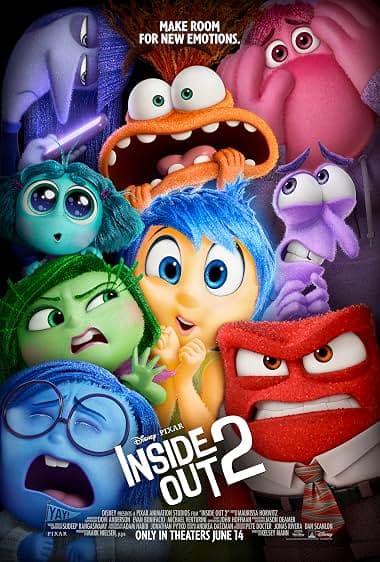
Riley turns thirteen, and the control console at Headquarters gets a demolition crew: Anxiety (Maya Hawke), Envy (Ayo Edebiri), Embarrassment (Paul Walter Hauser), and Ennui (Adèle Exarchopoulos) crash in overnight, shove Joy (Amy Poehler), Sadness (Phyllis Smith), Fear (Tony Hale), Anger (Lewis Black), and Disgust (Liza Lapira) into a backroom, and start renovating Riley's entire sense of self around a hockey camp weekend that's going to decide which high school she ends up at. Anxiety, convinced she's the only emotion qualified to keep Riley safe, exiles the old guard to the back of the mind alongside Riley's actual childhood memories, then builds a new Belief System out of nothing but worst-case scenarios. What follows is less a quest than a panic attack stretched into a third act, with Joy and company racing the storage system to get back to the console before Anxiety's anxious architecture becomes who Riley actually is.
Maya Hawke's Anxiety is the best screen depiction of what anxiety actually feels like that a major studio has put in front of a nine-year-old, and that's the whole movie's spine. She's not a mustache-twirling villain, she's a well-meaning emotion who genuinely believes she's protecting Riley, which is exactly what makes her takeover so unsettling: every bad decision she pushes Riley toward is dressed up as preparation. The film earns a lot of goodwill just by refusing to make her the bad guy.
Joy's arc, learning that some memories just get to be messy instead of curated into a tidy "sense of self," is the one genuinely new idea the sequel has, and it's a good one. The first film was about Joy learning Sadness has a job to do; this one asks whether Joy's instinct to build Riley a clean, flattering self-image was ever healthy in the first place. Watching her let go of that control is the most mature thing this franchise has attempted.
Anger, Fear, and Disgust get benched for almost the entire runtime, and the movie barely notices. The first Inside Out made every emotion feel load-bearing; here, three-fifths of the original cast is reduced to comic relief doing bits in the background while Anxiety and Joy run the actual plot. Lewis Black still gets his laughs, but a sequel built around "there's room for every feeling" shouldn't leave half its emotions unemployed.
The Sar-Chasm and the imaginary friend Bloofy's self-aware riff on how absurd this franchise's internal mythology has gotten is the funniest stretch in either film. Pixar leaning into the silliness of its own high-concept premise, complete with a deadpan brain cop and a vault of embarrassing memories literally buried alive, shows a confidence the rest of the sequel's more self-serious stretches could've used more of.
The climax resolves Riley's panic attack through a rapid-fire memory montage instead of letting the moment breathe, and it's the one place the film visibly runs out of patience with its own idea. After an hour of carefully, painfully building out what anxiety does to a thirteen-year-old's brain, cutting to a highlight reel to fix it in ninety seconds feels like the script hit its runtime and reached for the fastest exit instead of earning the landing the setup deserved.
The verdict: a genuinely smart, frequently moving sequel that understands adolescent anxiety better than almost anything else aimed at kids, anchored by a career-best vocal performance from Hawke and a real emotional upgrade for Joy. It just can't quite manage five new emotions and five old ones without benching half the roster, and it cashes out its hardest-earned tension for a shortcut ending.
So why only five shakers? Because sidelining Anger, Fear, and Disgust for an entire movie after building an ensemble around them, and then rushing the one scene the whole film was building toward, are real structural shortcuts, not nitpicks, from a studio that usually has the patience to earn its endings.
So did Pixar grow up as much as Riley did? Mostly, yes, but growing up also means learning not to rush the hard conversations, and this one still does.
Pass the salt. 🧂