⚠️ Contains spoilers.
🧂 Gladiator II (2024)
Ridley Scott remembers everything about the original except why anyone cared about Maximus in the first place.
Directed by Ridley Scott. Distributed by Paramount Pictures. 2024.
🧂 Salt: 6 / 10. A legacy sequel that spends two and a half hours proving it can restage the original's greatest hits, then forgets to give its own hero a reason to exist. and ⭐ Stars: 6 / 10. Big, loud, frequently gorgeous, and held together almost entirely by a supporting performance the movie doesn't fully deserve.
Rome was never the dream. Rome was always just the biggest cage with the best view.
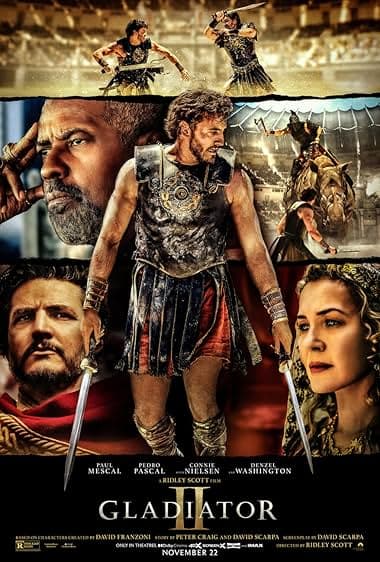
Sixteen years after Maximus died in the sand, Ridley Scott returns to the Colosseum with Lucius (Paul Mescal), living a quiet exile in Numidia under a different name, until General Acacius (Pedro Pascal) leads a Roman invasion that kills his wife and drags him back to the empire he's spent his whole life running from. Sold into gladiatorial slavery, he's bought by Macrinus (Denzel Washington), a former slave turned power broker with his own designs on the throne currently warmed by twin emperors Geta (Joseph Quinn) and Caracalla (Fred Hechinger), two of the most entertainingly unhinged Caesars Rome has produced on screen. The bones of the first film are all here, dead family, a path to vengeance that runs through the arena, a general's daughter with divided loyalties, and Scott restages them with real craft. The problem is he restages them instead of building something that justifies the return trip.
Denzel Washington's Macrinus is the only character in the film operating on his own agenda, and he's clearly having more fun than anyone else in the cast. Washington plays him as a man who's spent a lifetime being underestimated and has decided the correction for that is total, patient ruthlessness, charming the emperors to their faces while arming the mob that will eventually eat them. Every scene he's in snaps into focus the moment he opens his mouth, which is both the film's biggest asset and a tell that the script knows exactly where its real movie is and chose to make a different one.
Paul Mescal's Lucius is physically committed and emotionally thin, and that's a script problem more than a performance one. Mescal sells the rage and the physicality of the fights fine, but Lucius spends most of the runtime defined by who his parents were rather than by any want of his own, a passive inheritor of Maximus's myth rather than a person the film bothers to build from scratch. Maximus worked because Gladiator made his grief specific before it made it symbolic; Lucius mostly just arrives already symbolic.
The shark-infested naval battle in a flooded Colosseum is the film's most purely absurd set piece, and also one of its best. Historically dubious and gleefully so, it's Scott leaning all the way into the spectacle of Rome literally restaging a sea battle for entertainment, sharks included, and it's a better argument for why this franchise still deserves a budget than most of the quieter political scenes around it.
Pedro Pascal's Acacius gets set up as a genuinely interesting moral center, a conquering general disillusioned with the empire he serves, and then the plot has almost nothing for him to do with it. His scenes with Connie Nielsen's Lucilla, reprising her role and still the most quietly effective actor in this franchise, suggest a whole other movie about people trying to do the right thing inside a rotten system. That movie gets about twenty minutes before the arena plot swallows it whole.
The verdict: a sequel that knows how to build a rhino-mounted gladiator brawl and a baboon ambush, and clearly less sure of what it wants to say about the empire it keeps restaging. Washington steals it outright, Pascal and Nielsen suggest a sharper film hiding underneath, and Mescal does solid, unglamorous work carrying a character the script never quite earns the weight of. It's never boring to look at. It's just rarely as interesting as the film it's standing next to.
So why only six shakers? Because a franchise built on the specific, hard-earned grief of one man shouldn't try to coast on inherited myth for its follow-up, and handing Denzel Washington the only character with an actual plan while sidelining Pascal and Nielsen is a real structural miscalculation, not a nitpick.
So did Rome deserve a second trip to the Colosseum? Mostly, yes, it's handsome, well-staged spectacle, it just forgot to bring its own Maximus.
Pass the salt. 🧂