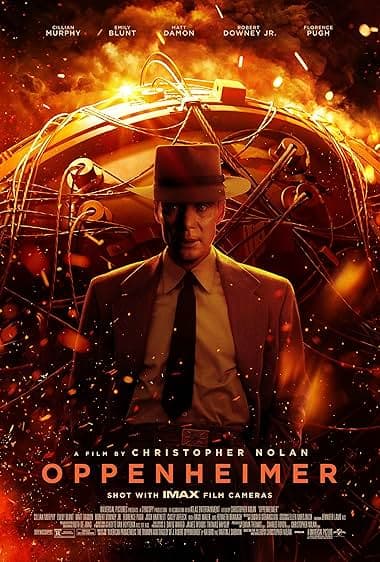
🧂 Oppenheimer (2023)
Three hours of men in rooms deciding the fate of the world, and somehow it never once feels like homework.
Directed by Christopher Nolan. Distributed by Universal Pictures. 2023.
🧂 Salt: 3 / 10. A handful of real gripes, but nothing that dims the achievement. and ⭐ Stars: 8 / 10. One of the best films of its year, full stop.
He split the atom. The atom got the better end of the deal.
Christopher Nolan has never met a nonlinear timeline he didn't want to overcomplicate, and Oppenheimer is the film where that impulse finally has a subject worthy of it. J. Robert Oppenheimer (Cillian Murphy) spends three hours being simultaneously the smartest man in every room and the last one to understand what he's actually built, and Nolan tells that story by braiding three timelines together: the Manhattan Project itself in lush color, a 1954 security-clearance hearing shot with the intimacy of an interrogation, and a black-and-white Senate confirmation fight for Lewis Strauss (Robert Downey Jr.) that turns out to be the film's quiet knife. It's a lot of scaffolding for what is, underneath it, a movie about a man who got exactly what he wanted and spent the rest of his life realizing that was the tragedy.
Cillian Murphy carries the whole thing on a face built for close-ups. Nolan shoots Murphy's eyes like they're a special effect in their own right, and by the back half of the film they basically are, wide and hollowed out, tracking the exact moment Oppenheimer stops being a physicist solving a puzzle and starts being a man watching the consequences arrive. It's a performance built almost entirely on restraint, and it's the reason the film's quieter scenes land as hard as its explosions.
The Trinity test is the best sequence Nolan has ever directed. No score, no dialogue, just a slow count and a group of men lying face down in a trench hoping the atmosphere doesn't ignite. Nolan holds the silence for an unbearable stretch before letting the blast wash over Los Alamos, light arriving before sound, and it's the rare blockbuster set piece that understands dread is scarier than spectacle. Everything after it, deliberately, feels like the hangover.
The Strauss hearing is where the film sneaks up on you. Downey Jr. plays Strauss as a wounded ego dressed up as a principled bureaucrat, and the black-and-white timeline that seemed like an academic structural flex for two hours quietly reveals itself as the actual engine of the plot, a study in how petty resentment reroutes history just as surely as physics does. It's the best work Downey has done in over a decade, and Nolan smartly lets the reveal of his motives land without underlining it.
Florence Pugh's Jean Tatlock gets the least room to breathe. Of the film's women, only Emily Blunt's Kitty gets a real arc, landing a devastating cross-examination scene late in the hearing that's one of the film's highlights. Tatlock exists mostly to illustrate Oppenheimer's contradictions rather than to be a person with her own, and for a film this exhaustively interested in interiority, it's a blind spot Nolan never quite corrects.
The dinner-table science montages occasionally mistake density for depth. Nolan crams an enormous amount of physics history and interpersonal politics into rapid-fire dialogue scenes, and while most of it is legible if you're paying attention, there's a stretch in the film's middle third where the sheer volume of scientists cycling through Los Alamos starts to blur names together. It's a small price for the film's ambition, but it's a real one.
The verdict: the movies rarely ask you to sit with the specific horror of getting exactly what you asked for, and Oppenheimer does it for three hours without flinching, anchored by a career-best Murphy and a screenplay that turns a bureaucratic hearing into the year's tensest thriller. It's dense, occasionally overstuffed, and never less than commanding.
So why only three shakers? Because the complaints here are the complaints you make about a film reaching for the top shelf, not one that got lazy. Tatlock deserved more interiority, and the science-history cramming occasionally overwhelms rather than illuminates, but those are footnotes on a genuinely major achievement, not the main event.
So, did Oppenheimer become death, destroyer of worlds? He became something worse: a man who has to live in the world he made.
Pass the salt. 🧂