⚠️ Contains spoilers.
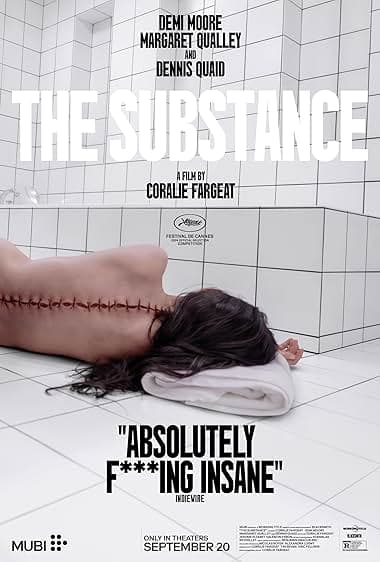
🧂 The Substance (2024)
Hollywood's beauty industry, dragged into an operating room and vivisected without anesthetic.
Directed by Coralie Fargeat. Distributed by MUBI. 2024.
🧂 Salt: 4 / 10. The excess is the entire point, but the finale still overstays its welcome by a good twenty minutes. and ⭐ Stars: 7 / 10. A go-for-broke body horror standout carried by the bravest performance of Demi Moore's career.
It wanted a better version of you. It got a warning label instead.
Coralie Fargeat's The Substance opens with a shot of a Hollywood Walk of Fame star being installed, admired, and slowly worn down by decades of indifferent foot traffic, and if that sounds like an unsubtle metaphor, congratulations, you've understood the assignment. This film isn't interested in whispering its themes. It wants to grab you by the jaw and make you watch what an industry does to women it decides are finished. Subtlety was never on the table. What's on the table instead is one of the ugliest, funniest, most fully committed horror movies in years.
The firing scene sets the terms. Elisabeth Sparkle (Demi Moore), an Oscar-winning actress reduced to hosting a daytime aerobics show, gets dumped by her network on her fiftieth birthday by Harvey (Dennis Quaid), a producer who delivers the news while chewing shrimp directly into the camera in a grotesque close-up that lingers just long enough to become unbearable. It's a two-minute scene that tells you everything about how this industry sees a woman who has aged out of usefulness, and Fargeat shoots Quaid's mouth like it's the real monster of the film, which, in a sense, it is.
The birth of Sue announces the film's language. Once Elisabeth injects the black-market Substance, her spine splits open and a younger, "better" version of herself, Sue (Margaret Qualley), claws her way across the bathroom tile in a sequence that plays less like a jump scare and more like a grueling, wet delivery. Fargeat refuses to cut away from any of it, and that refusal becomes the film's whole methodology: the body horror is never gratuitous for its own sake, it's always in service of making you feel, physically, what these women do to themselves to stay employable.
The one rule they can't follow. Elisabeth and Sue are supposed to "balance," alternating control every seven days while the dormant body lies fed through a tube. Sue, naturally, starts stealing extra hours because she's having too much fun being wanted again, and each theft costs Elisabeth's body something irreversible: a gnarled finger, a ruined eye, a spine curling in on itself like old paper. It's a brutally literal metaphor for how younger beauty standards cannibalize the women who came before them, and the film never lets you forget that Sue and Elisabeth are the same person waging war on herself.
The spiral nobody warned her about. The saddest stretch of the movie isn't a gore sequence at all, it's Elisabeth alone in her apartment, dressed for a date with an old classmate, catching a glimpse of a Sue billboard through her window and wiping the makeup off her own face in disgust before canceling. Demi Moore plays that scene with a rawness that has nothing to do with prosthetics, and it's the reason the film's satire lands as hard as its gore does.
The finale earns the reputation and tests your patience. When Elisabeth, humiliated and desperate, overdoses the Substance to bring Sue back for a New Year's Eve special, the two fuse into "Monstro Elisasue," a lurching atrocity that staggers onto a live stage and detonates into a geyser of blood over a screaming audience, Carrie's prom soaked in gasoline and set alight twice over. It's a genuinely astonishing practical-effects achievement, and also about four minutes of blood-hosing longer than the joke needs to land. Fargeat knows exactly what she's doing by then, and does it anyway, past shock and into simple, gleeful excess.
So why only four shakers? Because that excess is a choice the film is fully in on, not a failure of control. The Substance isn't accidentally too much, it's a movie about too-much-ness, made by a director who knows a beauty industry built on impossible standards deserves a monster this loud thrown back in its face. The finale runs long enough that a few later gags dilute the ones before them, and that's a real flaw, but it's the flaw of an artist who refused to pull the punch, not one who didn't know where to aim it.
The verdict: A blunt, brilliant, deeply gross piece of body horror that says exactly what it means about aging, beauty, and self-hatred, anchored by a career-best Demi Moore. It runs a little long and never once whispers when it could scream, but by the time the credits roll in a puddle of viscera, you understand that was always the point.
So, does the Substance deliver a better version of you? For about seven days at a time, sure. Ask it for a refund after that.
Pass the salt. 🧂