⚠️ Contains spoilers.
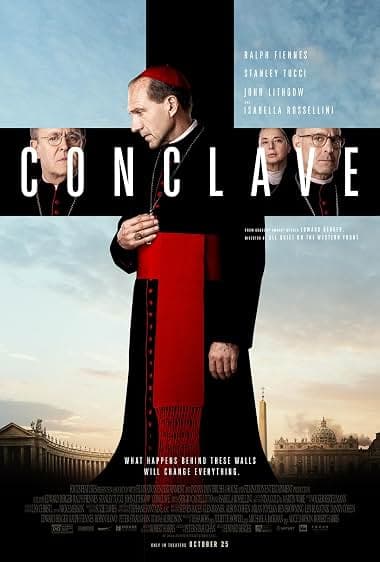
🧂 Conclave (2024)
White smoke, black hearts: watching cardinals scheme for the papacy has never made backstabbing look so tastefully lit.
Directed by Edward Berger. Distributed by Focus Features. 2024.
🧂 Salt: 5 / 10. A pulpy thriller in a cassock that occasionally trusts its twists more than its themes. and ⭐ Stars: 7 / 10. A genuine standout, tense and gorgeously controlled, even if it's more soap opera than sermon.
Somewhere in the Vatican, ambition just put on a red hat and called itself humility.
Edward Berger's first English-language film after the bruising All Quiet on the Western Front trades trench warfare for a different kind of attrition: a papal conclave, where the cardinals get locked inside the Sistine Chapel until white smoke rises, and where Cardinal Thomas Lawrence (Ralph Fiennes), the dean tasked with running the whole circus, discovers that the closer you get to men who've spent their lives performing humility, the more you learn about what they're actually willing to do for power. Adapted from Robert Harris's novel, Conclave plays like a locked-room thriller that happens to be about faith, and for two tightly wound hours it mostly gets away with it.
Ralph Fiennes plays doubt like it's a full-body condition. Lawrence spends the film wanting nothing more than to be relieved of his duties, and Fiennes turns that reluctance into the movie's real suspense engine: every time he uncovers another cardinal's secret, you watch a man who'd rather not know anything try to convince himself he has no choice but to keep digging. It's a masterclass in playing a character defined by what he refuses to want, and it's the reason the film's talkiest stretches never go slack.
Isabella Rossellini barely speaks for most of the runtime, and steals the whole conclave anyway. As Sister Agnes, the nun quietly running the cardinals' domestic affairs, Rossellini says almost nothing until she's finally given the floor, and delivers it with a stillness that makes every cardinal in the room look like a child caught mid-tantrum. The film clearly knows exactly what it has in her, which makes it even stingier that it doesn't give her more to do before that moment.
Stanley Tucci and Sergio Castellitto turn ideology into pure theater. Tucci's liberal Bellini and Castellitto's reactionary Tedesco stake out the church's culture war in real time, one horrified by the idea of a "war" with Islam, the other openly campaigning for it, and their scenes together have the crackle of a walk-and-talk transplanted into vestments. It's a smart shorthand for the actual stakes of the vote, even when the film leans on the two of them a little too hard as a stand-in for subtlety.
The Adeyemi scandal is where the plot machinery starts creaking. A cardinal's decades-old indiscretion resurfaces at exactly the moment the story needs a jolt, courtesy of a payment record that turns up right on cue to blow up the front-runner's chances. Berger stages the reveal with enough control that it mostly plays, but it's the first sign that Conclave is more interested in twists landing on schedule than in twists earning their surprise.
The final reveal is the swing that will decide how much you liked everything before it. Cardinal Benitez's identity, saved for literally the last scene, is handled with a delicacy that keeps it from feeling exploitative, and Fiennes's quiet, almost amused reaction is the smartest possible way to land it. But it also retroactively turns two hours of Vatican power-broker intrigue into a much simpler parable about who deserves grace, and the pivot arrives so late there's no time to sit with it as anything but a mic drop.
The verdict: a beautifully shot, note-perfect thriller that treats the papacy like a hostile boardroom takeover, carried by a career-caliber Fiennes performance and a script that knows exactly how to keep a room full of old men in red arguing without ever getting boring. It occasionally mistakes a plot contrivance for a moral one, and its best supporting player gets criminally underused.
So why only five shakers? Because a story this confident shouldn't need a ledger to show up on cue to manufacture its midpoint crisis, and Sister Agnes deserved to be more than the conclave's most efficient scene-stealer. Real structural complaints, not a knock on how tightly the rest of it is wound.
So, did the Holy Spirit pick the next pope? No, a screenwriter did, and thankfully he was good at his job.
Pass the salt. 🧂