⚠️ Contains spoilers.
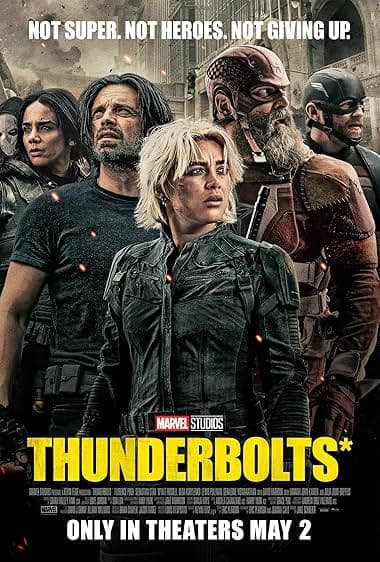
🧂 Thunderbolts* (2025)
Marvel finally admits half its heroes are a disaster, locks them in a vault with a suicidal superman, and the resulting group therapy session is better than it has any right to be.
Directed by Jake Schreier. Distributed by Walt Disney Studios Motion Pictures. 2025.
🧂 Salt: 5 / 10. Hard to stay mad at a movie that's this upfront about its villain being a metaphor for depression instead of another guy with a glowing MacGuffin. and ⭐ Stars: 6 / 10. A genuinely good MCU entry with a real emotional center, undercut by a third act that can't resist reverting to standard sky-beam plumbing.
The scariest thing Marvel has ever put onscreen isn't a monster. It's a guy who just wants everyone to stop pretending they're fine.
Jake Schreier's Thunderbolts* opens with CIA director Valentina Allegra de Fontaine (Julia Louis-Dreyfus) facing an impeachment hearing over a black-ops program she can't let surface, so she does the obvious thing: send her expendable assets, Yelena Belova (Florence Pugh), Bucky Barnes (Sebastian Stan), John Walker (Wyatt Russell), Ava Starr (Hannah John-Kamen), and Antonia Dreykov (Olga Kurylenko), into a vault to kill each other and bury the evidence. Instead they find Bob (Lewis Pullman), an amnesiac test subject who turns out to be the product of her secret super-soldier program, and realize they're all the loose ends being tied off. What starts as a double-cross becomes a jailbreak, and what starts as a jailbreak becomes, improbably, a support group, because Bob isn't just powerful. He's a walking relapse, and when he breaks, he doesn't throw a tank, he erases people into black smoke until an entire city block is gone.
Florence Pugh is doing the real load-bearing work here, and the film knows it. Yelena opens the movie flatlined, cracking jokes about her own hollowness between kills, and Pugh plays that numbness as a specific, recognizable thing rather than generic brooding. The script lets her be funny and genuinely checked-out in the same breath, which is a harder note to hit than most capes movies even attempt.
Lewis Pullman's Bob is the best thing Marvel has cast in years, and the film is smart enough to underplay him. He's twitchy, apologetic, visibly embarrassed by his own power, and when the Void starts leaking out of him, Pullman keeps playing scared long after the movie could've let him play menacing. The Void isn't an alien or a god. It's a panic attack with city-leveling consequences, and Pullman sells the person trapped inside it.
Julia Louis-Dreyfus's Valentina is a masterclass in banal evil, and also the film's biggest missed opportunity. She's never once interested in world domination, only in not losing her job, and that smallness is the funniest, most pointed thing in the movie. But she gets neutered by the midpoint, reduced to a punchline instead of a threat, when a villain this specifically petty deserved to stay dangerous all the way through.
The Void sequences are the film's best idea rendered in its laziest visual language. Turning depression into a literal shadow that swallows people whole and traps them in their worst memory is genuinely sharp writing, the sequence of New Yorkers getting erased mid-sentence is unsettling in a way these movies rarely risk. But the execution is pure generic CGI smoke-monster, and a movie this clever with metaphor deserved an antagonist that looked like more than a Funko Pop of The Nothing from The NeverEnding Story.
John Walker and Ava Starr get recruited, bicker for two acts, and then barely matter when it counts. Wyatt Russell and Hannah John-Kamen are both doing solid work with scraps, Walker's humiliation over losing his Captain America status to Sam Wilson still stings him in ways the film gestures at but never digs into, and Ava's entire arc resolves offscreen between movies. For a film built around a found-family ensemble, two-fifths of the family mostly stand in the back.
The verdict: a Marvel movie with the nerve to make its final battle an act of empathy instead of a laser beam contest, anchored by Pugh at her most wounded and Pullman in a star-making turn. It's smarter about trauma than almost anything else in the franchise, and it still can't fully escape the house style once the credits start angling toward the next crossover.
So why only five shakers? Because a film this upfront about its own themes shouldn't still need a generic shadow-monster climax to prove the stakes, and benching Valentina's menace and shortchanging Walker and Ava are real structural choices, not just nitpicks. Credit where it's due: this is one of the few recent Marvel entries that actually earns the salt it avoids.
So did Marvel actually make a superhero movie about depression instead of just using the word? Mostly, yes, and it only flinched back into formula once the credits needed a hook for the next one.
Pass the salt. 🧂