⚠️ Contains spoilers.
Most movie sites will tell you Toy Story 5 is good. It is: a solid six. That's not the problem. The problem is that it's good in a way that quietly takes the wind out of your evening, and we're the only ones who'll say so out loud.
On story, it works. It makes a thoughtful, even tender argument that you make real friends by being your authentic, unfiltered self, not by performing a polished little avatar for people who were never going to love the real you anyway. Lovely message. Now here's everything it did to leave you salty.
The Buzz overload. Fifty commemorative Buzz Lightyears crash down stuck in toy mode, all hunting for Star Command, and it's charming for about ten minutes. Then the film discovers what these units can do and never stops showing you. Each set piece escalates the gimmick until you can see the writers' room through it. By lap three you stop laughing and start checking the runtime. That's a crime worth getting salty over, and it's committed against a Buzz Lightyear.
The cardboard dad. Bonnie's father is written as such a glassy nonentity, thumbs always on the screen and eyes always elsewhere, that he stops being a character and becomes the thousandth movie dad who means well and does nothing. In a movie trying this hard everywhere else, it's the laziest possible shorthand, and it stings every time he's on screen.
The benched legends. This is the big one. Woody and Buzz, the two characters who built this franchise, spend most of the movie as confused sidekicks who are always three steps behind, reacting to a plot that's moved on without them. Yes, it's Jessie's movie now, and Joan Cusack rips. But the film never decides whether it's honoring its old heroes or quietly retiring them, so they just drift in the background looking as lost as you feel watching them. That's the kind of thing that wrongs you on a personal level.
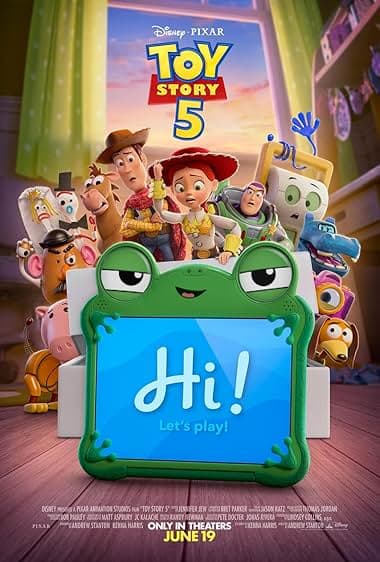
It's not even a toy movie. It's a screen movie. The villain, Lilypad, is a smart tablet shaped like a frog and voiced with eerie sweetness by Greta Lee, and she's one of Pixar's best in years precisely because she means well. She's the road to hell paved with good intentions, rendered in adorable amphibian UX. Everything isolating she does, she does because she sincerely believes she's helping Bonnie. When the movie charges at that question of how much of our kids' lives we've quietly handed to the device that promised to make everything easier, it's genuinely frightening, and genuinely great.
So why only four on the salt scale, not more? Because the movie keeps earning its goodwill back. For every gut punch of a benched hero there's a Lilypad scene that actually lands, a Jessie beat that works, a line about screens that sticks. The salt is real. The heroes get sidelined, the dad's a cardboard cutout, and you leave wistful rather than relieved. But it's a simmer, not a boil. You don't walk out furious. You walk out a little sad, a little salty, and oddly impressed. That's a six star movie that wronged you just enough to sting.
The verdict: A thoughtful, openly sad movie wearing the costume of a kids' matinee. The grownups leave quiet, the little ones leave vaguely uneasy about the tablet that babysits them, and nobody leaves relieved. Worth seeing. Just don't expect to feel better.
So, does that sound like a fun movie to bring your kids to?
Who knows. Pass the salt. 🧂