⚠️ Contains spoilers.
🧂 The Wild Robot (2024)
A customer-service robot accidentally kills a family of geese, adopts the last surviving egg out of programming-adjacent guilt, and still models better parenting instincts than most live-action prestige dramas.
Directed by Chris Sanders. Distributed by Universal Pictures. 2024.
🧂 Salt: 4 / 10. A film this gentle barely gives you anything to be mad about, which is its own minor problem. and ⭐ Stars: 7 / 10. A genuine standout of its year, gorgeously made and emotionally honest without cheap sentimentality.
Somewhere on an uninhabited island, a machine built to complete tasks discovers the one task with no completion screen: raising a kid who isn't yours, isn't a goose by choice, and definitely isn't in the manual.
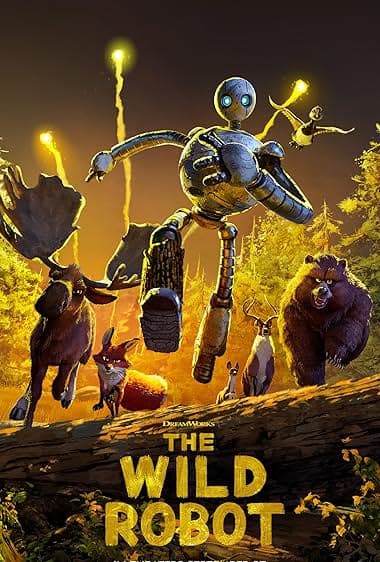
Chris Sanders' The Wild Robot strands a ROZZUM unit named Roz (Lupita Nyong'o) on an island with no humans to serve, which is a problem, because "serve humans" is the entirety of her programming. She adapts by learning the local wildlife's language, crushing a goose's nest by accident in the process, and leaving exactly one egg intact. That egg hatches into Brightbill (Kit Connor), the runt of a species that measures worth in flying formation, and Roz spends the rest of the film doing the one thing she was never built for: raising him, with a scheming fox named Fink (Pedro Pascal) recruited from "predator" to "co-parent" along the way. It's a survival story that keeps insisting it's actually about a goose learning to fly south, and a robot learning that "task" was always a euphemism for "love" the whole time.
The nest-crushing opening is the boldest five minutes in a kids' movie all year. Most animated features spend their first act establishing likability. This one opens with its hero accidentally flattening a family, and it doesn't flinch from the guilt that follows, it just quietly redirects it into Roz's decision to raise the one survivor. It's a genuinely uncomfortable choice that the film earns instead of glossing over, and it sets a bar for emotional honesty that the rest of the movie mostly clears.
Lupita Nyong'o threads a needle most robot performances don't even attempt. Roz has to sound like a customer-service unit reciting scripted pleasantries and, gradually, like something closer to a mother, without the film ever letting her stop being a machine. Nyong'o's line readings get warmer in increments so small you don't notice the robot became a parent until you're already crying about it.
Pedro Pascal's Fink is the funniest element in the movie and the most predictable. His arc, opportunistic scavenger who wants to eat the gosling, then wants to protect him, then can't remember why he ever wanted otherwise, is exactly the arc you'd sketch on a napkin for "wisecracking sidekick learns to care." Pascal's delivery makes every beat of it land anyway, but the film never bothers disguising where it's headed.
Vontra and her RECO units are the plot's engine, not its argument. Universal Dynamics wants its malfunctioning unit back, so it sends a retrieval robot to get her, and that robot exists almost entirely to manufacture a third-act chase and a forest fire. The film has genuinely interesting things to say about a machine outgrowing its assigned function; it has almost nothing to say about the company that built her, and Vontra never becomes more than an obstacle with a voice.
The painterly, impressionistic backgrounds are the one thing the movie refuses to rush. Every frame of the island looks brushed rather than rendered, and the film trusts that texture to do emotional work dialogue would otherwise have to carry; the changing seasons alone tell you more about the passage of time and the stakes of winter than any line of narration does.
The verdict: a beautifully made, unfashionably sincere film that earns its tears instead of extracting them, anchored by a Nyong'o performance that never oversells the robot's transformation and a visual style that trusts silence and color over exposition. It stumbles only when the plot needs an antagonist and reaches for the nearest corporate drone instead of a genuine idea.
So why only four shakers? Because there's shockingly little here worth getting mad about. Vontra's a thin villain and the fox's arc is telegraphed early, but neither is a betrayal so much as a movie occasionally taking the easy route to get back to what it actually cares about. Save the real salt for films that waste a good premise; this one mostly doesn't.
So did a machine with no maternal programming actually become a better parent than the plot needed her to be? Yes, several times over, and the island noticed before she did.
Pass the salt. 🧂