⚠️ Contains spoilers.
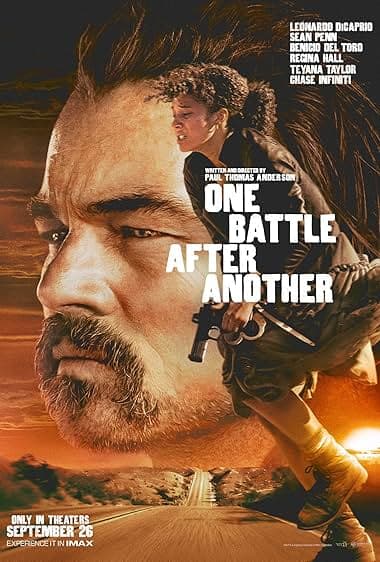
🧂 One Battle After Another (2025)
A washed-up revolutionary spends sixteen years getting stoned on a couch, and the movie somehow convinces you he's still the most competent adult in it.
Directed by Paul Thomas Anderson. Distributed by Warner Bros. Pictures. 2025.
🧂 Salt: 6 / 10. A film this sprawling and self-assured is going to leave bruises when its sprawl occasionally outruns its control. and ⭐ Stars: 7 / 10. A genuine standout of its year, propulsive and genuinely funny in ways PTA has never fully allowed himself before.
Sixteen years of hiding didn't make Bob Ferguson a better father. It just gave him a better couch to be a bad one from.
Paul Thomas Anderson's One Battle After Another opens mid-raid, with the revolutionary cell French 75 storming a border detention camp, and it's already clear this isn't a tidy origin story. Perfidia Beverly Hills marches into Colonel Steven J. Lockjaw's tent, strips him of his weapon and his hat, and leaves him humiliated in a way he'll spend the rest of the film pathologically trying to undo. She has a daughter, Charlene, with fellow revolutionary Pat Calhoun, abandons them both to keep fighting, gets arrested, and trades her comrades' names to Lockjaw to save herself. Sixteen years later, Pat and his daughter live under assumed names, Bob and Willa Ferguson, in a sanctuary town called Baktan Cross, where Bob spends his days stoned, drunk, and rewatching The Battle of Algiers like a man studying for a test he already failed. Loosely adapting Thomas Pynchon's Vineland, the film cares less about nostalgia for the movement than what's left of a person once the movement is gone and only the paranoia remains.
DiCaprio plays Bob as a man whose competence has entirely relocated to the wrong decade. He can't remember a phone number or hold a thought past his own fear, but he still knows, bone-deep, how to disappear, how to case a room, how to not get his daughter killed. It's a genuinely funny performance, DiCaprio hasn't had this much room to be a shambling disaster in years, and the film trusts the comedy enough to let his incompetence be the joke without making his love for Willa the punchline.
Sean Penn's Lockjaw is undone by a humiliation he's nursed for sixteen years, and the film never lets him grow out of it. His obsession with Perfidia hasn't cooled into professional menace; it's curdled into something closer to a fetish, and when hunting Willa resurfaces that old wound, Penn plays it less like a villain closing in and more like a man still trying to win an argument he lost in the first ten minutes. It's his best work in years precisely because the film never lets him be cool about it.
Benicio del Toro's Sensei Sergio is the film's moral ballast, and he barely has to raise his voice to provide it. As Willa's karate instructor and the man Bob turns to when the raid goes sideways, Del Toro plays calm as quiet defiance, a community actually organized around protecting its own, against the French 75's grand, failed theater of revolution decades earlier. He doesn't get a showy monologue, and he doesn't need one.
Chase Infiniti, in her film debut, carries the thankless job of being the only clear-headed person in a movie full of adults still working through their damage. Willa isn't written as a prop to be rescued so much as a kid who has quietly out-matured the men protecting her, and Infiniti plays that gap without ever tipping into precociousness.
The Baktan Cross raid is where the film's two engines, comedy and dread, run at full throttle together, and mostly it works. Protesters, police, and military collide in the streets while Bob fumbles toward Willa in a half-blackout, and Anderson keeps cutting the tension with absurdity without fully releasing it. The strain shows in the back half's extended hill chase: a bravura, nausea-inducing piece of pure filmmaking craft that runs long enough to remind you this is a nearly three-hour movie that didn't need every one of those minutes.
The verdict: a loose, live-wire epic about what's left of conviction once the people who held it have scattered, powered by a DiCaprio performance that finally finds the comedy in his usual intensity and a Penn performance built entirely on wounded pride. It's one of the most purely alive American films of its year, even when its back half can't resist chasing its own momentum a little too far.
So why only six shakers? Because a film this confident in its control occasionally forgets that velocity isn't the same as momentum, that hill chase earns its awe and overstays it in the same breath, and Lockjaw's backstory gets more runway than Deandra and the rest of French 75's surviving network ever does. Real structural gripes, not a dismissal of how much is actually firing on screen.
So did Bob Ferguson ever actually become the father Willa needed? Barely, and mostly by accident, but the couch finally got him off it in time.
Pass the salt. 🧂