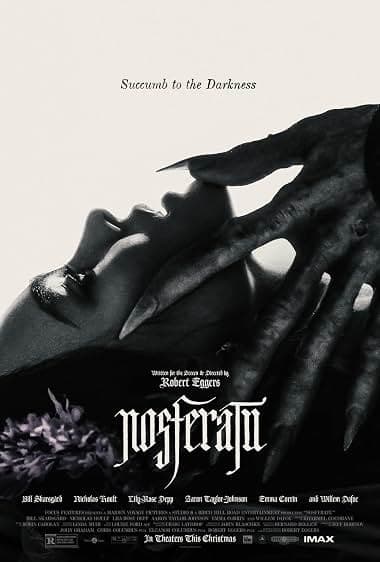
⚠️ Contains spoilers.
🧂 Nosferatu (2024)
A hundred-year-old shadow puppet show gets a bigger budget, a hornier subtext, and somehow still remembers to be scary.
Directed by Robert Eggers. Distributed by Focus Features. 2024.
🧂 Salt: 5 / 10. Hard to stay mad at a remake this committed to its own weird, musty conviction, even when it occasionally confuses a lecture for dread. and ⭐ Stars: 7 / 10. A genuine standout of its year, a studio horror film that actually looks and moves like nothing else in theaters.
Ellen Hutter didn't invite the darkness into her life. She just never stopped answering when it called.
Robert Eggers doesn't so much remake Murnau's 1922 silent classic as excavate it, keeping the skeleton, Thomas Hutter traveling to Transylvania to close a real estate deal with a client who turns out to be an ancient plague in a decaying coat, and rebuilding the muscle and nerve around it from scratch. The real engine here isn't Thomas (Nicholas Hoult), it's his wife Ellen (Lily-Rose Depp), whose childhood "melancholia" turns out to have been a psychic tether to Count Orlok (Bill Skarsgård) all along. Eggers isn't interested in a jump-scare machine. He's interested in a woman whose body has been telling the truth about her own desire for a century, while every man around her, husband included, insists on a more comfortable diagnosis.
Lily-Rose Depp spends the movie convulsing through possession-trance sequences that could have been embarrassing, and she makes them the most unsettling thing on screen. Her Ellen arches and seizes like something is trying to climb out of her spine, and Depp commits so fully to the discomfort of it, gasping, grinding, half-speaking in Orlok's voice, that the film's central metaphor, repressed desire as literal monster, lands as skin-crawling rather than silly.
Bill Skarsgård buries his entire face and voice under Orlok's rot, and the film is smarter for obscuring him. Eggers keeps Orlok in deep shadow and distorted silhouette for most of the runtime, a guttural Transylvanian growl doing more work than any close-up could, so that when he's finally seen in full, decayed, moustached, utterly wrong, it actually costs something. It's the rare modern monster movie that understands restraint is scarier than a reveal.
Willem Dafoe's Von Franz is the film's most purely enjoyable performance, and also its biggest crutch. As the disgraced occultist professor who alone believes Ellen, Dafoe chews through every scene with gleeful, unhinged conviction. But he's also stuck delivering chunks of vampire-lore exposition that stop the film cold to explain rules Eggers' imagery was already communicating better on its own.
Nicholas Hoult's Thomas Hutter gets steadily sidelined by his own movie, and it's the one structural choice that doesn't fully pay off. He's meant to represent a rational world too small for what's actually happening to his wife, but the script gives him so little interior life once he returns from Orlok's castle that he mostly just stands around reacting to Ellen and Von Franz, a passive observer in his own marriage and his own haunted house.
The verdict: a gothic horror remake with real teeth, anchored by a ferociously physical Depp performance and some of the most purely confident shadow-and-candlelight filmmaking in recent studio horror. It occasionally mistakes a lecture for atmosphere and strands its nominal hero on the sidelines, but it closes on an ending, Ellen choosing her own sacrifice rather than being rescued from it, that finally gives the 1922 original's victim some agency back.
So why only five shakers? Because a film this confident in its imagery shouldn't need Von Franz to stop and explain the vampire rulebook twice, and benching Thomas for most of the back half leaves a hole at the center of the marriage the movie is ostensibly about. Real structural notes, not a dismissal of how deliberately the rest of it is built.
So did Eggers actually improve on a hundred-year-old silent classic? Mostly, yes, by finally letting the woman at its center want the monster instead of just surviving him.
Pass the salt. 🧂