⚠️ Contains spoilers.
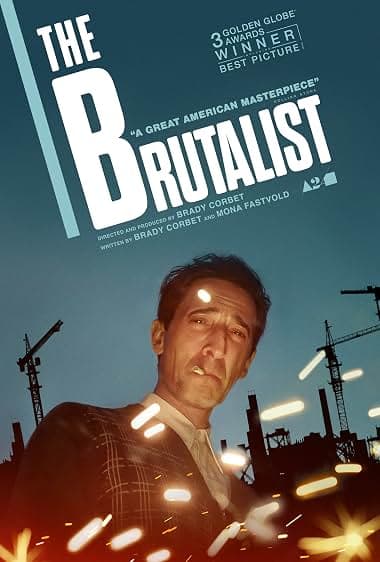
🧂 The Brutalist (2024)
215 minutes, one instructed intermission, and a genius immigrant architect who spends three and a half hours building a monument for a rich man who will never actually see him as human — call it prestige cinema's longest receipt.
Directed by Brady Corbet. Distributed by A24. 2024.
🧂 Salt: 6 / 10. A film so committed to its own scale that it occasionally mistakes duration for depth. and ⭐ Stars: 7 / 10. A genuine standout of its year, formally audacious and shot like nothing else in theaters.
Give a visionary a patron, and eventually the patron starts asking to see the blueprints for your soul.
Brady Corbet's The Brutalist opens with an overture, literally, credits over an inverted Statue of Liberty, before splitting into two hulking parts and an epilogue, because a film about a man forced to build on someone else's terms was apparently not going to build itself modestly either. László Tóth (Adrien Brody), a Bauhaus-trained Hungarian-Jewish architect who survived Buchenwald, arrives in Pennsylvania with nothing, gets folded into his cousin Attila's furniture business, and is eventually discovered by Harrison Lee Van Buren (Guy Pearce), an industrialist who commissions him to design a towering community center as a monument to Van Buren's late mother. His wife Erzsébet (Felicity Jones) and mute niece Zsófia join him years later, by which point László has already learned the arrangement's real terms: talent, in this country, is something a rich man rents.
Adrien Brody plays exhaustion like it's a second language. Every scene asks László to hold two things at once, gratitude for the commission and quiet fury at what it costs him, and Brody never lets one fully cancel out the other. The film is at its best simply watching him work: the way he sketches, the way he negotiates for concrete he can't get, the way his face goes still whenever Van Buren reminds him, gently, who's actually paying for the vision.
Guy Pearce's Van Buren is a monster built entirely out of good manners. He never raises his voice, he compliments László constantly, and every kindness comes with an invoice attached. The film's ugliest turn, at the Carrara marble quarry, where admiration curdles into violation, works precisely because Pearce has spent two hours making Van Buren's charm feel almost sincere. It's the rare performance where the reveal doesn't feel like a twist so much as a bill finally coming due.
The Overture-Part One-intermission-Part Two-Epilogue structure is a genuine formal swing, and it doesn't always land. Shooting in VistaVision gives the architecture and the Pennsylvania quarries a scale and texture that modern digital cinematography rarely bothers with, and the fifteen-minute intermission is a nice provocation in an era of streaming attention spans. But the back half sags in exactly the places the story most needs momentum, and by the time the epilogue arrives to explain what the building's proportions were "really" about, the film is telling you a thesis it had already shown better in silence.
Felicity Jones's Erzsébet arrives a shell of the woman László remembers, and the film underuses what that could mean. Confined for stretches to a wheelchair by osteoporosis, she's given one genuinely great scene, publicly detonating Van Buren's reputation at his own party, and not nearly enough screen time before it to make the marriage's toll feel fully earned rather than reported.
The verdict: an enormous, formally serious film about the specific violence of being someone else's genius on loan, anchored by a career-best Brody performance and a Pearce turn that makes politeness feel like a weapon. It's one of the most ambitious American films of its year, and its reach occasionally exceeds a script that needs its epilogue to say out loud what the previous three hours had already built, brick by brick.
So why only six shakers? Because a film this attentive to what concrete and marble cost shouldn't need a coda to spell out its own metaphor, and Erzsébet's reckoning deserved more runway than one late confrontation. Real structural gripes, not a dismissal of how much genuine craft is stacked up on screen.
So did László ever actually own what he built? No, the deed stayed with the man who signed the check, right up to the epilogue that tries to hand it back to him anyway.
Pass the salt. 🧂